Podcast Transcript
Tom Schultz
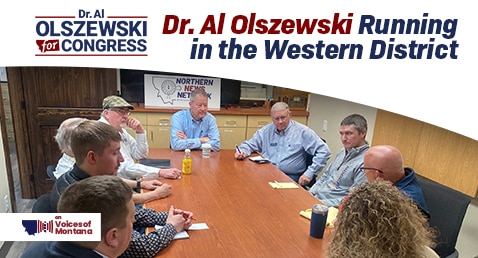
I think a lot of us agree there’s a lot of key issues that we’re trying to solve in this country. And those issues have divided us in a lot of ways. And those issues need solutions. And maybe there’s some good solutions coming from different areas as well. But one thing we do need is leadership. when it comes to addressing the problems and moving forward to a solution. And that’s why we’re talking an awful lot with candidates here during this primary season. And we’ll do it on through the general election as well, because leadership matters. And you’re going to be picking not just someone who’s going to vote. You’re going to be picking someone who is going to lead, right? That’s what we’re doing here. And you have a chance today to find out about the leadership qualities and the direction and the policy of Dr. Al Olszewski, candidate for U.S. House, Montana’s Western District, that today on Voices of Montana. We’re getting along here, aren’t we? It’s a primary season comes and goes so fast, right? And then we just forget that there’s two kind of election seasons. And so it drags on, it seems like. But these are very important times for us. So thank you for making us a part of your Montana Day and making this put this on your plate as well as a way to get informed. We need informed voters here today. And that’s why it’s a pleasure to have in studio Dr. Al Olszewski here, Kalispell, Montana, orthopedic surgeon, Air Force veteran, former Montana legislator, and Republican candidate for the U.S. House seat over there. How are you?
Dr. Al Olszewski
Hey, Tom, I’m doing great. Hey, good morning, Montana.
Tom Schultz
Isn’t it beautiful? Isn’t it beautiful to be able to say that?
Dr. Al Olszewski
You know, over here, I swear that you get springtime 2 weeks faster than we do in Kalispell.
Tom Schultz
Well, that’s probably a bad thing because then we dry out a little bit faster too. Although you guys have had a rough time getting water. up in your area.
Dr. Al Olszewski
Well, I’m going to tell you, we’ve been wet. We’ve had a winter that never was, but it really, we’ve had three small mini winters. It comes and goes, comes and goes. Fortunately, the snowpack high up is about, was estimated to be about 90% of normal. So, you know, we’ll take that.
Tom Schultz
There are some good indication when it comes to what our moisture levels are going to be, but also some very bad indications too. So we’ll see. A lot will be known here in the next few months. And a lot will be known here, Dr. Al, in the next few months as well about the direction for Montana and this house seat, the Western District House seat. Obviously, I think you want to, we can address that right away. There was some controversy in how late the, you know, Ryan Zinke, the current congressman announced he was not running. That’s his decision. There was time for everybody who wanted to get in the race to be in the race even before that decision. And then Aaron Flint, who worked for Ryan for a while, had the rollout ready to go. So, and you guys have, you guys, conservatives have criticized this. You’re picking a candidate for us. kind of approach. And I know that that is, that set the stage kind of for this. So let’s get past that. What do you think of that?
Dr. Al Olszewski
In a heartbeat, let’s remember, Benjamin Franklin said that we have a republic if we can keep it. And George Washington defined a republic as a form of government that consists of constitutional laws, unity, and the consent of the people to freely elect their own representatives. Hey, I read the US constitution and it doesn’t anywhere that our federal representatives get to select their successors and we consent by our vote. You know, that’s not a republic. So that’s where my resolve is, is the fact that I jumped in this race to give you a choice in opposition to just consenting for a single candidate. And here we are, we’re gonna finish what we almost completed in 2022, and that is to win the Republican parliament for this Western district.
Tom Schultz
It’s one of the advantages, but also one of the criticisms is that you’re a perennial candidate, 212, the Lieutenant Governor, US Senate, 2018, again, 2020 and 2022. How do you respond to that criticism?
Dr. Al Olszewski
I am a perennial candidate. Look, when you are not baptized and anointed by the establishment, and by special interest groups, you have to build your brand through grassroots. And you know what? The people of Montana, they don’t give their trust and confidence to anybody very easily. So yeah, it comes through a series of being successful and through different transactions. And one of those is to run for election, be elected as a state house or representative, then be elected as a state senator, develop that experience. and then move forward. And again, if you watch the track record, I’ve gone from 10% of the votes statewide to 20% of the votes statewide to 40% of Western Montana in the last race. And that’s how you build momentum. And I’ll take that over being bought and paid for by Washington, DC.
Tom Schultz
What was the response when that happened and you were, you know, kind of still on the sidelines, I guess, or waiting to be called into play there? How did you decide so quickly that you needed to step up here.
Dr. Al Olszewski
You know, I will tell you that there was something that wasn’t right. We watched our current congressman in the Western district, you know, he was going around to Lincoln Reagan dinners and to the GOP kickoff in Great Falls. And he was talking about, you know, Trump and the agenda, but he never talked about himself. So he either became more humble or something else was going on. Then the second hint that something was going on was that our former football player did not jump into the ballot process on the first day like he’s done so many times before. And that also meant that something else is going on. So, you know, I had a talk with my wife and said, Look, this, you know, he may not be running. And she very quickly said, Look, if that’s the case, then you’re back in. I told her, Look, I can stay home. I got 4,000 foot of fence and 20 trees to take care of this. this summer. And she said, that can wait. If he’s not in the race, too many people have invested in you and believe in you and you need to jump in the race. So when this occurred, when Ryan made that a surprise announcement, I turned to my wife and she says, what are you waiting for? So we sat down and in between journalists and legislators calling saying, get in the race. I just picked up my phone and I got myself on the ballot probably about an hour after Ryan made that decision, an announcement.
Tom Schultz
Well, I’m glad for that too, because I do appreciate an open process here. Once again, it is Dr. Al Olszewski with us. He has served 13 years in the U.S. Air Force as a flight surgeon, trauma surgeon, rising to the rank of major as well during his military career and served in the Montana legislature. Campaigns are different now, Al. It seems like, I mean, you can go back to 2012 and a few years, I guess maybe a lot of us can, but the… It just seems like the level of critical decisions that need to be made in our country now cannot wait. And so I think elections are very important, but they’re also full of misinformation. They’re also full. I mean, there’s a whole industry out there and we’ve seen it when they attack, you know, conservative stance on public lands that is, you know, gets paid for messaging. How do we, as the general public, sift through all that and try to find out what’s true and what’s not, and what’s gonna happen if this guy does get in office?
Dr. Al Olszewski
You know, what you’re pointing out is something that’s been going on for really for centuries in our country, but that in the age of electronics and social media, it is just unbelievable to watch the shock and awe of what someone can do in a negative way towards another person. Look, as an old statesman told me as a freshman legislator in Helena, he said, Look, conflict is currency. You need to get comfortable with the conflict and you need to, don’t let it, don’t take it personally and work through it. And it really does take then through that conflict is to be able to have a one-on-one conversation or a group conversation and continue to work and find common ground. Look, last time, In 2022, Ryan Zinke and I were neck and neck with one month to go. And unfortunately for me, Ryan’s campaign spent almost $1,000,000 in 10 days calling me a pathological liar and that I exaggerate my military career. The truth is, how do you exaggerate a military career when your honorable discharge papers, the DD form 214, is less than one page long? Look, I’m not a warrior. I fix warriors. That was what I did. I’m an Air Force veteran. I’m not a combat warrior. Did I jump out of an airplane five times at free fall school? I did. Did I fly jets as a flight surgeon? Yes, I did. 184 hours of instructor time. I was at an instructor base. That doesn’t make me a pilot, but I had the time of my life in the military, and I want to thank everybody in Montana who pays their taxes for all of that gas that we used for flying jets and for those airplanes that took me up and dropped me out of the airplane.
Tom Schultz
Well, thank you for that service too, Alan. And it’s an area that you don’t feel like you have to defend, but yet in today’s world, I guess everything is fair to question.
Dr. Al Olszewski
Right, well, and again, I’m a doctor. That’s not who I am. That’s a title. I’m an Air Force veteran. Is that who I am? It’s a title. It’s an experience. I’m Dr. Al Olszewski. I’m a husband, I’m a father, I’m a son, I’m a Montanan. And with the vote and consent, I will be the freely chosen next congressman for Western Montana.
Tom Schultz
Look, and we’re going to open up the phones here. In fact, Skip is on the line standing by, and we’ll do that here too. It’s 866-627-5483. Again, if you want to call, it’s 866-627-5483. Text a message, 781-627-5483. I’m going to pick up another issue that is difficult and is full of conflict. And then when you say conflict is currency, I don’t think the GOP spent their currency very well. The state GOP spent their currency very well when it came to there was an opportunity in my mind, Al, with with Trump’s election to the office. People were tired of, you know, the lawlessness being, you know, propagated out there. They were tired of a lot of things that that men were playing women’s sports and that third graders were being taught about gender dysphoria. There was just a lot of things wrong. And I think a lot of people responded to that. I thought there was a window for conservative values, or at least the GOP as a party to pick up more votes there. But in Montana, the party doubled down in a different sort of way. And I know that has been a conflict that is probably more magnified in the legislature and in those GOP circles than elsewhere. But tell us, talk about that, talk about that opportunity. Were you guys is making the perfect the enemy of the good. And I shouldn’t say you guys, but should I, the state GOP, but you are the head of the GOP party in Flathead County, right?
Dr. Al Olszewski
Yeah, so yeah, I’m a chairman of the Flathead County Republican Party, the largest county of Republicans on the Western side. And I would stand to say that we’re really close to Yellowstone County here up in the East. Look, again, conflict is currency. But what we watched at the state level is that last legislature, we had nine Republican senators that basically left the Republican Party, kept the R behind their name, and caucused with the Democrat Senate, creating a new majority that it was Democrat and you could call it a solutions party. And in that situation, they ruled and they ran the Republican or the Senate during the last legislature. So fast forward then to June of last year and, or following that, and what we saw was that the Montana state party, Republican party got together and all the voting members across the state, said, Look, we want to hold them accountable. That they basically left our party without dropping the R. And they were, they were not allowed to be seated at the convention by the vote of the people at the convention. And then further, the voting members of the Montana Republican Party statewide said, We wanna know who are new candidates that say they’re Republican. And we wanna look at the voting record of all Republicans that say they’re Republican. And what are we going to compare it to? We’re going to compare it to the Montana Republican state platform. Very simple. It’s out there. And just want to know, where do you stand? Do you agree with it all? Do you agree with part of it? You don’t agree with part of it? Because when you’re a legislator or even a legislative candidate with the state party, you have a vote. And we have our platform committee convention occurring again on June 12th in Missoula. And we’re going to sit down again and once again say, do we agree with this platform or do we need to change it. So that’s the conflict. There are people who run in Republican counties as a Republican, because that’s how you get elected. They don’t have the, or they don’t believe in the party platform. There are people who get elected as Democrats in Democrat counties. And they don’t believe in the Democrat platform. They’re pragmatic. They’re transactional. I call them not rhinos. I call them chamber Republicans and chamber Democrats because they seem to be supported by the chamber here in the state of Montana. Guess what? Here’s the joke. What’s the difference between a chamber Republican and a chamber Democrat? Yeah, the answer is nothing. right? They believe in corporate welfare and they believe in decreased regulations on them. They believe that we should be taxed, but they shouldn’t be. It’s an interesting proposition.
Tom Schultz
Dr. Al Olszewski is in studio with us here today, Republican candidate for the Western District and primary upcoming on June 2nd. And in that race is Christy Jacobson, as well as Aaron Clint. And we’ve spoken with some Democrats as well on the other side. And we’ll have more lined up. I’ve got invitations off of Ryan Bussey and you can go to our podcast page, voicesofmontana.com and catch up on those interviews. And we’ve got some phone calls to get to, but Dr. Al, again, thanks for coming in here and thanks for your service. And I want to talk a little bit because as we chatted a little bit before, and it’s Al for montana.com to get more information and to download on these issues that we’ll hopefully get to too. But you grew up as part of a ranching family in the Blaine County area and you were sharing that that homestead is ready to transfer. I mean, and you’re doing it in a way I think that would make a lot of Montanans proud.
Dr. Al Olszewski
Yeah, I’ll tell you. Yeah, for full clarification.
Tom Schultz
Yeah.
Dr. Al Olszewski
You know, my cousins grew up on that farm and on the other side of my family, my cousins grew up on the ranch in Judith Basin County. I’m a boy born and raised in Great Falls. When my grandfather sold the farm to my uncle, my dad left Hoagland as a Hoagland Hawk and had to go to Great Falls and he graduated from Great Falls Central Mustangs. So I got the opportunity and privilege to go spend time up on the farm in Blaine County, north of Harlem. It’s a place called Hoagland. And my cousin Gary had the farm and unfortunately he passed away. And my cousin Pat is, he retired from farming on the other side of the border in Saskatchewan. And look, my aunt, Mary, God bless her, did, I think what is one of the greatest things is that, you know, through my uncle and my grandfather, as they built that farm, putting pieces together of other families who didn’t do well in the depression or their family members, there was no one to transition. They built this beautiful farm with multiple sections of property. And you know what? It’s transitioning to a neighbor. for the next generation, for their kids to use it and be productive on the land. It didn’t go to corporate farming. It didn’t go into a conservation easement. It didn’t turn into a subdivision. And that’s the greatest gift that we can have is a transition to independent farmers for another generation to grow our food for us here in Montana.
Tom Schultz
That exemplifies what I think Montana’s values are toward agriculture, and that is stewardship. And And that is, in my mind, I hope to hear more and more of those stories across the state of Montana. So thank you for sharing that.
Dr. Al Olszewski
Well, you’re welcome. You know, and just in that part too, I have over 50 cousins and most of them live in Montana. Not all have Al Olszewski behind their name. But at the state fair this last summer, I ran into one of my cousins from Glasgow. And he said, You know, Al, you’re the only person I know that would spend hundreds of thousands of dollars to teach Montana how to pronounce Olszewski.
Tom Schultz
So we’re still getting it wrong though, aren’t we?
Dr. Al Olszewski
Oh, no, you know, again, for those that need to say it fast, you can say old jet ski. And if you’re like Governor Gianforte at a couple Lincoln Reagan dinners, he called me Dr. Oh So Sexy.
Tom Schultz
All right, I’ll go with that one. No, I won’t. We’ll play it a little bit more.
Dr. Al Olszewski
No, no, no, you’re not the governor.
Tom Schultz
Yeah, that’s right, thank you. Skip and Hamilton. Skip, thanks for listening and calling in today, KLYQ Country. Good to hear from you. You’re on the air here with Dr. Al Olszewski.
Speaker 3
Oh, and thank you, Tom. Good morning, Dr. Al. I try not to pronounce your last name. I’ve always just called you Dr. Al and you seemed okay with that. And so, and I don’t think you’ve been a perpetual candidate or a perennial candidate, I think you’ve been a perennial teacher. Every time I’ve been in your presence, I’ve learned something important about everything from our natural resources in Western Montana to things about the military and things to have our antenna up for so we don’t get sideswiped. I wanted to I wanted to ask you about something that that you were a teacher of for a long time for the last many years and you and I discussed this before and it has to do with the East Salish Water Pact that you know the history of and the substance of, because there was a piece of legislation a few years ago in Washington, in Congress, that the brag was that it solved 97% of the water issues in the state of Montana. Well, I happen to live in the other 3%. And I wonder if you could update me on exactly where we stand in the future, and is there other ways that we can solve that other 3% in the future? And it’s exciting that you’re running. I hope everybody learns a lot in this election cycle, and I’ll just leave it at that, sir.
Tom Schultz
Thank you. Nice comments, Skip. And with that question, that sets the stage for the next 30 days, I think, or three hours here, to go back and talk about that water compact, and there’s a lot into it. You have to go back into the original treaty. You have to understand some of the dynamics to come up with the way people are positioning it.
Dr. Al Olszewski
Yeah, you know, again, as all of our ranchers and farmers, understand that have senior water rights. Water rights are complex and you can’t talk about them in two minutes. I’m not an expert on the CSKT Water Compact. I’m a student of it, but a student that’s been working with it and fighting against it and opposing it since 2012. In essence, what we have is a third of the state and our federal government took the water rights of Western Montana gave it to a third, a smaller third party without renumeration and without it being adjudicated by a judge. It was done so unconstitutionally. And I was part of the suit as a legislator that took it after the 2015 legislature to the Montana Supreme Court. They disagreed with us. But then again, as the legislative branch, we disagree with the judicial branch. So we’re in that situation. The truth is, that at the federal level, The DOJ legal theory is that the supremacy clause Trump’s contract law and it Trump’s state law. So if that’s the case, and they don’t want to go to court because they know they’ll lose. That’s why they’re giving a small third party of 5,000 people on a tribal reservation over $2 billion. and they’re giving them 36,816 acres of federal land to replace that land that’s private within the reservation. This is a taking without renumeration or with adjudication by a judge. I’m against it, and we can change it. The big one, as you just said, is that through the Supreme Court rulings, and we can go back to Old Man Winters up on the High Line, a rancher back at the turn of the century who stopped water going onto a reservation up on the High Line. And basically the US Supreme Court said that we need to quantitate a water right to every reservation. And it needs to be enough to make those peoples pastoral and civil. Despite all of this compact, that water right has not been quantitated. And I’m gonna do that first and foremost. We’re gonna quantitate how much water does 5,000 people need on a reservation in Western Montana. They do not They don’t need all the water of Western Montana. They just need some of the water.
Tom Schultz
I appreciate that. I mean, the we can change it aspect of it. And how do we do it legally and in our process? Talking with candidates in the primary election, Dr. Al Olszewski in studio. It’s good to see you in studio, Al. Thanks. I mean, you made a trip. It’s from Kalispell.
Dr. Al Olszewski
Well, you know, it’s only 7 1/2 hours, 8 if you go the speed limit.
Tom Schultz
Okay. So you made it in six then? Is that what you’re saying? No, Okay.
Dr. Al Olszewski
I know people who can make it in six and I will not drive with them.
Tom Schultz
I know. Gotcha. Montana regained its second seat over there in 2020 with the 2020 census. The first election was in 2022, right?
Dr. Al Olszewski
That is correct.
Tom Schultz
Yeah. And Al Olszewski in studio here. We got issues I want to talk about here. And Brenda’s going to pick up on one of those listening in Kalispella. Love that big stick up there. KOFI got a lot of friends. 1180 A.m. on the 4.3. Brenda, good morning. You’re on the air here with Dr. Al Olszewski.
Speaker 4
Good morning and thank you. Hello, Dr. Al Olszewski. How are you this morning?
Dr. Al Olszewski
I’m mostly awake. Thank you.
Speaker 4
Thank you. Well, you know, I’d like to comment on what you were talking about, the water compact and to the chagrin of most Montanans. Senator Daines did push that through, and most people are really, really upset about that. But speaking of water problems, most Montanans that I’ve talked to recently are really concerned about the AI data centers, the potential of those going in, again, because we feel one out of 15 Montanans seem to want them. The rest of them do not want them because of the possible water pollution, energy consumption, noise level, and so forth. Now, we know that Senator Daines is pro these data centers, and we know from listening to Montana Talks that your competitor, Aaron Flint, is for these data centers too. Can you give your thoughts on those, Dr. Olszewski? Thank you.
Dr. Al Olszewski
Thanks, Brenda. Again, as we look at all issues, and this is a very good example, I’m gonna use a Montana first philosophy. Again, looking through the lenses, does it make us free? Does it help our families? And does it make life in Montana affordable? So I’m opposing artificial intelligence data centers in Montana. the following reasons. Does it make it affordable? Look, we need high paying jobs and artificial intelligence is a big threat to Montanans who have white collar jobs, who work remotely or work physically in Montana, that they’re gonna be replaced. So how do you stay, how can you afford to raise your family if you’re put out of business by artificial intelligence? Number two is that, again, we’re dealing with the water issues, as you said, we know that it requires significant amount of water to cool these data centers. And that has a great risk in polluting or contaminating our water sources. And we have pristine water here in Montana. We have to be very, very careful about making sure that we stay free. And freedom means that we have water that’s freely given and freely drank. Number, and then finally, We cannot have affordability in Montana if we’re competing against data centers for the electricity. It is estimated from reading the articles here in Montana is that the amount of electricity needed for all data centers proposed is 200% of what we currently use for all consumers in Montana. Where does that come from? Now, I hear people saying, Well, they’ll make their own nuclear plant. That’s unconstitutional in Montana at this point. But again, If we’re competing for electricity with data centers, it goes up in price and it makes Montana even more unaffordable. So these are the reasons that I pose it. And as a congressman, as I said, my lens is for the people of Western Montana and Montana of all, and that’s gonna have my first priority.
Tom Schultz
I’ll play devil’s advocate because I’m leaning more towards supporting them because you wanna keep things affordable, you’ve got to be competitive with the rest of the world, and if we don’t have the kind of technology that it takes to make us competitive, then we’re not going to have opportunities for affordability. In my mind, the water thing has been misdirected by some groups out there. There’s new technology that, and we had members of the AFL-CIO on the program to talk about how they support these and how people understand like 6 million gallons a month or a year. I’m hearing all kinds of different things. And they tell me the amount of water in a closed system will be the amount of usage for about a three house apartment building on a yearly basis. So, but the energy side is I’m with you on that. I don’t buy necessarily that they can bring their own power to this. Let’s get into that conversation. Brenda, thank you for your call about it. Energy, the math is not adding up. We’ve been this rush, irrational rush to renewables and they want to take out dams and that’s the cleanest and cheapest form of alternative power, even though they don’t want to call it alternative power. That’s exactly what it is. They don’t want to call it because then we have enough alternative power to meet their mandates. What’s your sense on energy? That’s another one of those complicated issues. And I’m with you. Affordable energy makes our economy very resilient.
Dr. Al Olszewski
Right. Again, what we need to do is we need to pay attention and know where we can find energy. We need reliable base load. We’ve seen that wind energy just doesn’t seem to work at 35 below zero. for two to three weeks at a time. And so, yeah, and it’s confusing, but we do need to pay attention. You know, Cold Strip is the proposal that we’re watching is that it’s gonna be put into a separate entity and that power may or may not be used for Montana. It may be used only for artificial intelligence data centers. You know, I think the big thing is, is within this conversation, we need to have successful discussions discussions and transactions or relationships, showing that we’re going to try to keep energy affordable in Montana for consumers. That consumers in Montana are not going to have to pay for all of those transmission lines and the creation of power generation for a third party that profits greatly at our expense. And then finally, let’s look for energy. And here’s a classic example. Did you know that there is a dam up on the Gibson Reservoir coming out of the Bob Marshall Wilderness? And it was designed to take a generator, electrical generator, to create tremendous amount of power for the area of central Montana. The problem is, is it never got its generator as promised. And so we can, at this point, at the federal level, we can designate and authorize and appropriate a generator to go in Gibson Reservoir. And now we’re creating, yes, renewable, sustainable power that’s hydroelectric that then will be added to our grid and it will be consistent and it will be for the benefit for all of Montana.
Tom Schultz
Dr. Al Olszewski, once again, energy, is a key thing here too, but I want to get on to healthcare because that’s another issue that I think we’re struggling with. and then, and then AI, I’ll go back to that because. I’m thinking, look, we need to have more open conversations about it. AI, it’s all over the board into how many jobs it could usurp, you know, 11% up to 40%. Some say not even. So we don’t know an awful lot about it. And we’re walking into it probably with blinders on in that regard. I know I got to save some time for healthcare, but let’s talk about what AI does to our society and if it does transition us into society where there are less employable opportunities, what does that do for our society?
Dr. Al Olszewski
Again, by and large, you know, any new technology is a tool and it can be used for good. It can be used for bad. I mean, are we not watching in politics what AI generated imaging can do? Can we see what it does for deep fake *********** what it does to hurt people? I mean, It can be a tool for good, but we’re watching it also being used as a weapon to hurt people, whether it’s their reputations or to a point of depression and suicide. So it does need to be regulated. I’m a Republican, I’m not a libertarian. I believe that we need to have ordered liberty. And that ordered liberty is such that we have a limited government that doesn’t winners and losers. Rather, it creates, it acts as an umpire or referee, and it keeps the playing field level for all people in the world of social issues and economic issues. And in this situation, there needs to be solid, well-based regulation on artificial intelligence so that we can mitigate that issue of weaponization and make sure that it’s being used as a tool for good.
Tom Schultz
And along that lines, healthcare is kind of in the same boat in terms of It’s going to require an open, honest, national conversation about where we’re going, because it seems like where we’re going, especially with the initiation of Obamacare now about 14 years ago, has been too socialized medicine. And the expense is something that we can’t keep up with. But yet we’re also understanding the more we pay, the less services we seem to be getting from our health care system. I mean, these are just common kind of observations from the pocketbook side sort of thing. What’s where are we at with health care?
Dr. Al Olszewski
You’re a good observer, and so are most Montanans. For those of us that experienced medical care before Obamacare, and to now know that there’s a significant difference. And it’s not for the good. What we’ve gotten is from a patient, our doctor-patient relationship with individualized healthcare to a hospital patient contract where you’re treated like cattle, you’re put through the chutes, and it’s called corporate medicine. And nobody’s happy with this. And again, for me, a definition as a doctor of healthcare is alleviating pain and suffering of the individual in front of me. For the corporate medicine mentality, the definition of healthcare is maximizing an income strength. stream for the entity. Okay. Very, very different. In my definition, you are a person. In that other definition, you’re cattle. Okay. So is healthcare a right? No. Is it a privilege? No. It’s a service. So if we remember that it’s a service, then let’s figure out, is it for the common good? And I believe it is. And if it is a service that is for the common good, we should, as American people, figure out how to set that up. And let’s look at electricity. Did we not believe that it should not be for the rich only? And that as a common good, we had authorities of government to make sure it’s available to everybody? Yeah, but it didn’t make it government subsidized, did it? Well, or it’s not a government program, it’s private, but it’s regulated in a different way. Why not healthcare like energy?
Tom Schultz
What will that, well, I’m gonna take a break ’cause I’m up against it. And I wanna get to your Montana first philosophy here as well to talk about that why you’re running and your call to public service. I think I got that date right, June 2nd for the primary election in Montana and your choices party wise, but also individually. Dr. Al Olszewski is in studio here. I’ve just got a few minutes to wrap things up. And I, again, Air Force veteran, I appreciate your service there. orthopedic surgeon, you started your own practice and saw, you know, healthcare from the inside, so to speak. And so you’ve got a lot of experience in these things. You know, what was your call to public service? And then talk about your main platform here, or what, if somebody says, Al, how will you lead? What’s your answer to that?
Dr. Al Olszewski
Well, again, a call to service started when I was very young. You know, like, as I said, my family homesteaded, you know, and they came from the old country, and my grandparents and great grandparents didn’t teach their children Polish or Slovakian, they taught them English. And there was two things that was passed on through these farming and ranching families and mining families, is that, you know, number one, you honor this family and everything you do, and you serve this country and this community. And that was the theme given, you know, throughout my childhood. So I’ve served, you know, whether it was a lifeguard, served in the military, served as a doctor or served in the legislature. So again, that’s my call to service. Why? It’s a family issue. It’s a family theme. It’s a mission. So let’s go back. Yeah. Montana first. Look, when I talk about Montana first, this is not a catchy thing. theme. This is not just words. This is what happens when you’re a perennial candidate. When you’re a grassroots candidate and you’re going around over the many years for different offices, you listen to the people. And this is really the issues that people want, especially in Western Montana, for their congressmen. What they want is someone who represents them, number one, and what their concerns are. Are we going to stay free? I want the government off my back. I want to do what I want to do as long as it’s reasonable and it’s not illegal, unethical, or immoral. Number 2, I want to raise my family and I’m struggling in this country in this state to be able to raise my family the way I was raised and have access to our, you know, to our public lands. You know, I have to now get a ticket to go to Glacier Park. I’m being told I’m going to have to get a ticket to go on Flathead River to start rafting. You know, and then Again, we need to make sure it’s affordable and it really is. So we need to look at all three of those things, not because it’s catchy, it’s because you told me it’s important and we believe, I believe in you. And so I’m gonna take that to heart. And that’s how I will serve as Western Montana’s next congressman.
Tom Schultz
What are you hearing on the campaign trail?
Dr. Al Olszewski
Oh, again, I’m hearing a lot. Number one is that the actions of Senator Daines and Congressman Ryan or Congressman Zinke at the very end of the balloting process, trying to select a successor and minimize the chance of other people to be in the process, that’s given me a heck of a tailwind moving forward. Number two is that I hear over and over, experience matters. And they said, look, doc, you’ve been a state legislator. in 2022, we chose the former congressman because he had more experience. In this election, you are the one with the most experience as a legislator. And therefore, we choose you.
Tom Schultz
Today’s political world is a challenge. I appreciate you throwing your hat in the ring and walking it out and giving us a chance to talk about everybody’s thoughts on all these issues, Al.
Dr. Al Olszewski
Absolutely. Again, that’s what this is about, is telling stories, sharing story, and let’s all buy into the big story.
Tom Schultz
And while you’re here, could you take a look at my elbow? I’ve got, it’s been, maybe it’s just an age thing. I don’t know.
Dr. Al Olszewski
Yeah, I can tell my, like my kids, I could amputate.
Tom Schultz
Voices of Montana. Thanks for joining us for the podcast and join us weekdays live from 9 a.m. to 10 a.m. for more Voices of Montana on great radio stations all across our Treasure State.