As tensions surrounding Iran continue to dominate global headlines, scholars and international policy experts will gather in Montana next week to analyze the conflict and its broader geopolitical implications.
Dr. Mehrdad Kia, a professor at the University of Montana and longtime organizer of the event, joined Voices of Montana to discuss both the latest developments in the Iran situation and the upcoming 23rd International Conference on the Middle East and Central Asia, scheduled for April 1–2 in Missoula.
The annual conference brings together scholars, policymakers, and international experts to examine security, diplomacy, and political developments across the region. According to Kia, the event has become a unique academic forum that has operated for more than two decades largely through private fundraising support from Montanans rather than public funding.
“For 23 years we have organized this conference, and it is entirely self-funded,” Kia said. “We do not receive support from the university or the state. The people of Montana have been incredibly supportive of these efforts.”
Iran Conflict Enters Critical Stage
The conference comes at a moment of heightened international tension involving Iran, including ongoing military conflict in the region and renewed discussions in Washington about potential negotiations.
Kia said the conflict has entered a critical phase, with debates intensifying over whether diplomatic talks should attempt to bring the war to a conclusion or whether pressure on Iran’s ruling regime should continue.
“There are voices in Washington pushing to wrap this up quickly,” Kia said. “But many believe the conflict should only end when the regime in Tehran capitulates, because that would also open the door to freedom for the people of Iran.”
Another major concern involves the global economic and energy impacts of the conflict. Iran has threatened to disrupt shipping in the Strait of Hormuz, a critical waterway through which a significant portion of the world’s oil supply passes.
Kia said international coalitions could play an important role in keeping global shipping lanes open and maintaining stability in the region.
“These waterways belong to the world, not to a single country,” he said, noting that several regional nations may increasingly cooperate to counter Iranian influence.
Scholars and Policymakers on Geopolitics
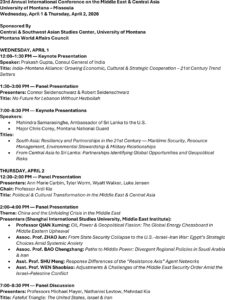
The upcoming conference will explore these issues in depth through multiple panels featuring international scholars and policy experts. The event is free and open to the public (full schedule below), with sessions running from noon to 8:30 p.m. on both days.
Topics will include South Asia security issues, Central Asian geopolitics, and the evolving relationship between major global powers in the Middle East.
One particularly notable panel will examine China’s role in the region, featuring scholars from Shanghai International Studies University who will discuss Beijing’s strategic interests as it balances relationships with Iran, Arab states, and the United States.
The conference will conclude Thursday evening with a major panel discussion focused on U.S., Israeli, and Iranian policy dynamics.
Kia said the goal is to give Montanans access to high-level international analysis typically found only at major academic or diplomatic forums.
“We want people to understand the complexity of what’s happening in this region,” Kia said. “These issues affect global stability, energy markets, and ultimately the security of the United States.”