
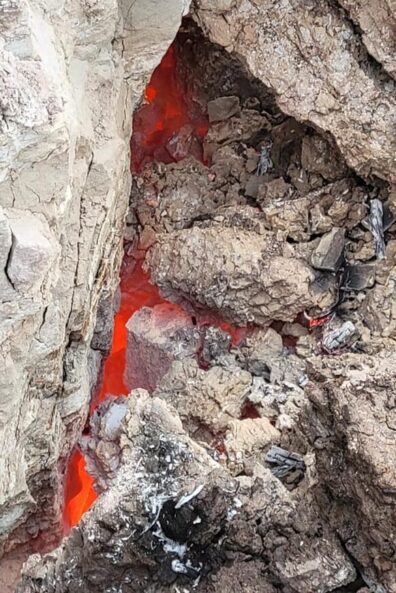
A Smoldering Chain Reaction
For decades, the rugged landscape of eastern Montana has been sitting on a literal “chain reaction” of fire. What begins as a simple lightning strike often ignites exposed coal veins, which then smolder underground for years—sometimes decades—only to resurface and spark massive, uncontrollable wildfires. These burning coal seams act as persistent, hidden ignition points across the rangeland. To break this destructive cycle, the Montana Department of Natural Resources and Conservation (DNRC) has officially secured federal funding from the U.S. Environmental Protection Agency (EPA). This critical funding allows the state to shift its focus from merely mapping these hazards to active “mitigation,” a term that Custer County Fire Warden Cory Cheguis explains simply as a long-awaited plan to finally put these fires out for good.
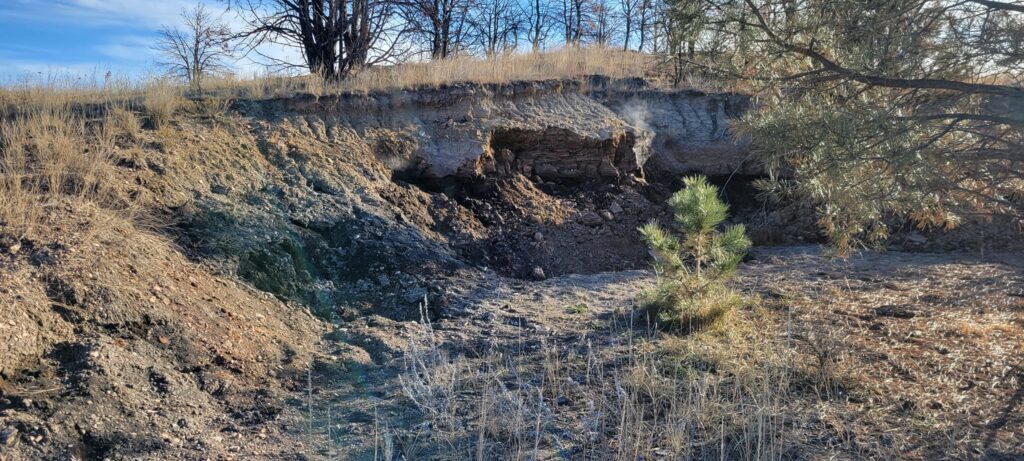
[Smoke rising from the ‘fluffy ground’ of a Montana hillside, marking an active underground fire.]
The Half-Million Acre Impact
The scale of the threat posed by these underground fires is staggering when viewed through the lens of recent history. Cory Cheguis describes these burning seams as “unattended campfires in the hills” that can ignite a disaster on any windy day. In the last decade alone, roughly 500,000 acres of Montana rangeland have been scorched by fires specifically caused by coal seam ignitions. A prime example is the 2021 Richard Spring Fire, which burned approximately 278,000 acres after starting from a coal seam west of Colstrip. The danger is not confined to the heat of summer; as recently as the first two weeks of March 2026, two separate wildfires were sparked by coal seams south of Colstrip, proving that these hidden fuel sources remain a year-round threat.
“These are essentially unattended campfires in the hills. We identified a problem, and we needed to come up with a solution because every year we have multiple wildfires started by coal seams.”
— Cory Cheguis, Custer County Fire Warden
From Mapping to Active Excavation
Since 2021, the DNRC has been laying the groundwork for this moment by using thermal drones and specialized aircraft to map burning seams across Custer, Rosebud, Big Horn, and Powder River counties. Now, the program is entering a “beta test” phase where the focus turns to the physical excavation method. This process involves using heavy equipment to dig out the burning coal entirely, removing the fuel source from the landscape. However, because every coal seam is unique in size and depth, the DNRC must first hire engineers and contractors to determine the exact cost per site before a final number of mitigated seams can be confirmed.
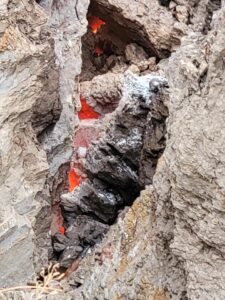
[A close-up of a cracked coal vein glowing with molten red heat just beneath the surface.]
Setting the Local Implementation Plan
To ensure the success of this local implementation, the DNRC is hosting a crucial stakeholder meeting at the Custer County Event Center in Miles City on Thursday, March 26, 2026, from 1:00 PM to 2:15 PM. This meeting is designed to inform landowners and public officials about how the program will work on a local level. The agenda will cover the specific criteria used to prioritize which fires are tackled first—focusing on those that pose the greatest risk to human safety and vital infrastructure. Officials will also explain the “Why” behind the urgency, detailing the long-term consequences of allowing these fires to continue burning, such as toxic gas release and land subsidence.
The Road Ahead for Landowners
For landowners, the meeting will be an essential opportunity to understand what to expect as mitigation work progresses across the landscape. The DNRC plans to coordinate closely with private property owners regarding land access, safety protocols during excavation, and the eventual restoration of the site. Cory Cheguis, who sometimes wears the hat of “Coal Seam Fire Mitigation Coordinator” in Custer County, emphasizes that while the program cannot guarantee every single identified seam will be mitigated in this first round, it represents a historic first step toward a permanent solution. This collaborative effort marks the beginning of a proactive era in Montana wildfire prevention.
At-a-Glance: Coal Seam Fire Mitigation Meeting
| Event Details | Location & Contact |
| Date: Thursday, March 26, 2026 | Venue: Custer County Event Center |
| Time: 1:00 PM – 2:15 PM | Address: 42 Garryowen Rd, Miles City, MT |
| Focus: Implementation & Landowner Rights | Web: dnrc.mt.gov |
Project Contacts:
- DNRC Program Supervisor: Lindsey Glastetter (Lindsey.Glastetter@mt.gov)
- Custer County Lead: Cory Cheguis (C.Cheguis@custercountymt.com)
Written by Cody Ross


