Montana Strengthens Digital Borders with First Cyber Warfare Officer
Posted: Cody Ross
Sourced: MTN News
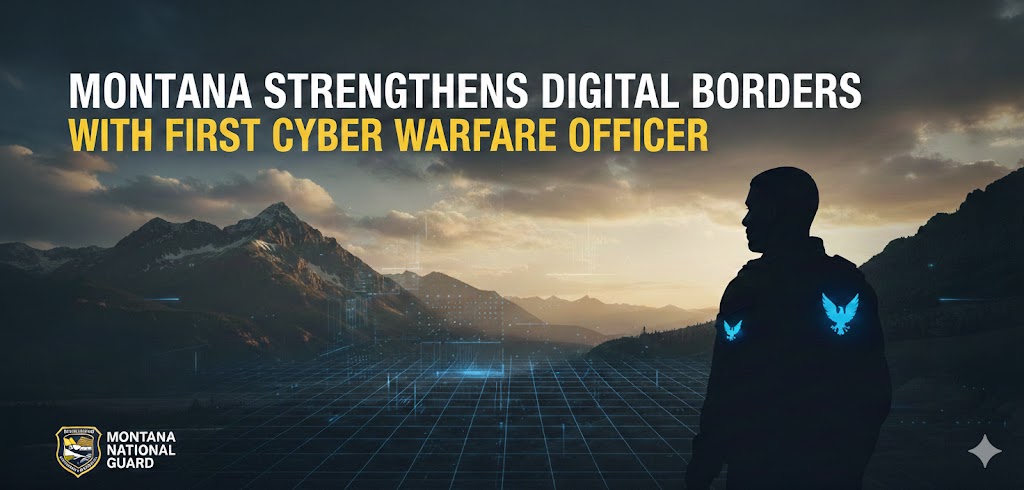
In a strategic move to modernize its defense capabilities, the Montana National Guard has officially appointed Chief Warrant Officer Joshua Williams as the state’s first-ever Cyber Warfare Officer. The appointment, announced in Helena, marks a fundamental shift in how the state perceives and responds to threats in the 21st century. By establishing this dedicated role, Montana joins a growing number of states recognizing that the front lines of modern conflict are no longer defined solely by physical borders, but by the digital networks that power essential services, schools, and private industry.
Chief Warrant Officer Williams brings a wealth of specialized experience to the role, having previously assisted in the recovery and defense of high-profile digital attacks within the state. His resume includes responding to the 2019 cyber-attack on Thompson Falls schools, an incident so severe it required a gubernatorial declaration, as well as the 2023 breach at Montana State University. In his new capacity, Williams will not only lead recovery efforts but will work proactively with community partners and mission stakeholders to fortify the state’s critical infrastructure before an intrusion occurs. As CW5 Travis Gronley, the state command chief warrant officer, noted, a desktop computer is now effectively the front line of the modern battlefield.
The integration of this role signals a major policy shift: cyber incidents in Montana will now trigger the same state-level emergency authorities traditionally reserved for natural disasters like wildfires and floods. This reclassification allows the National Guard to deploy resources and personnel with greater agility. Major Travis Light, the Montana National Guard cyber team chief, emphasized that while the “flavor” of a digital attack is unique, the command structure for responding to it—directing resources and making rapid executive decisions—mirrors the proven strategies used in physical emergencies. This ensures that when local systems are compromised, the state can respond with the same urgency as it would to a rising river or a spreading forest fire.
Beyond immediate defense, the Guard is viewing this milestone as an opportunity for workforce development and recruitment. As the “unseen infrastructure” of public safety networks and hospitals becomes increasingly targeted by global adversaries, the need for specialized personnel has skyrocketed. The Guard has announced that new career paths are opening for enlisted members, warrant officers, and commissioned officers specifically within the cyber domain. This expansion aims to create a sustainable pipeline of local talent capable of defending Montana’s economic security and daily way of life, with new positions even being made available for direct enlistment.
Ultimately, the appointment of Williams underscores the reality that modern warfare is increasingly hybrid, utilizing both kinetic and digital strikes to achieve strategic goals. By treating a network intrusion with the same defensive gravity as a physical outpost, Montana is positioning itself to stay ahead of evolving threats. As Williams observed, the ability to anticipate adversary moves in the digital landscape is no longer optional; it is a critical component of state and national security in an interconnected age.